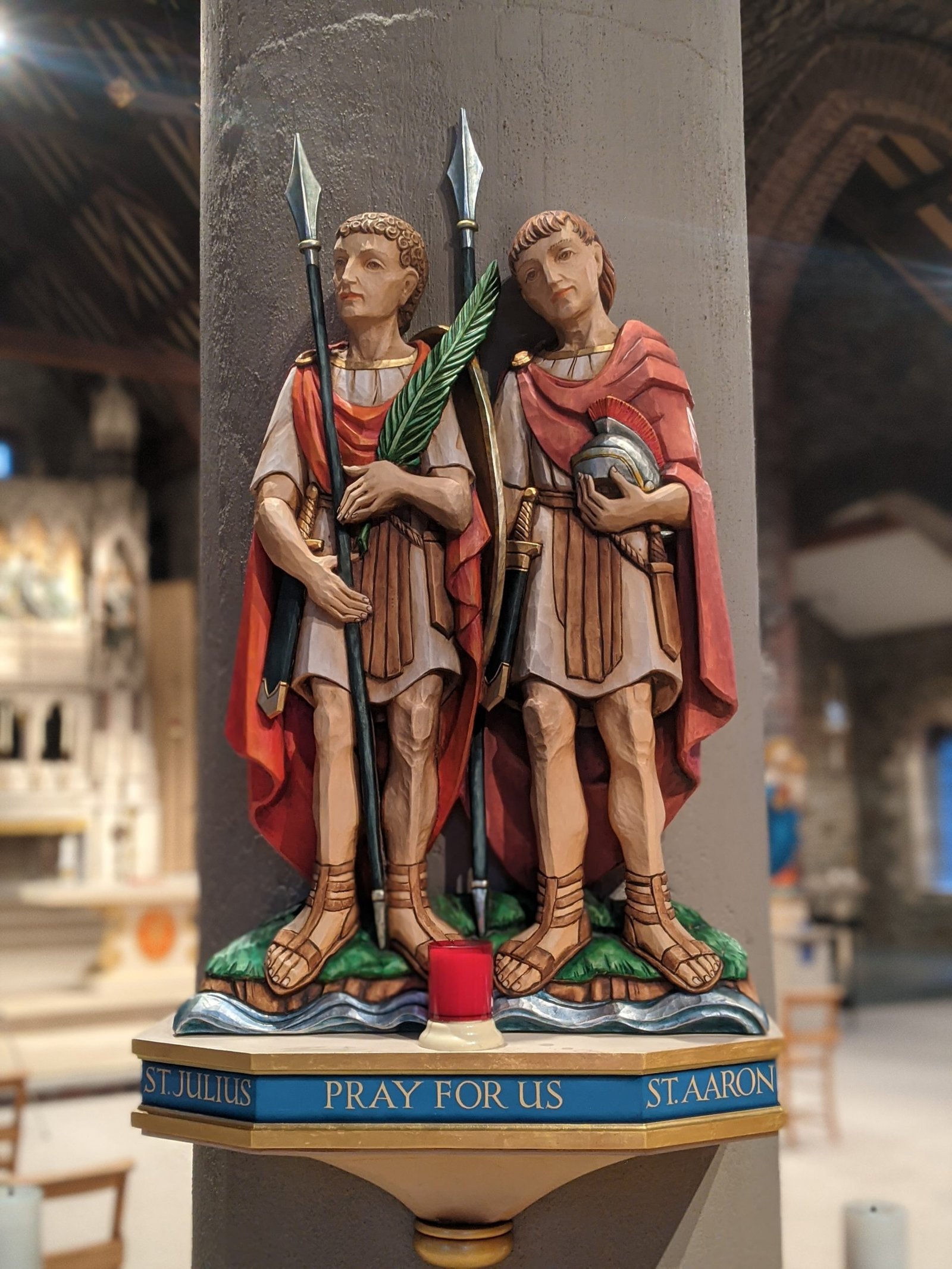
Standing within the bounds of our present parish, let us go back in time some seventeen centuries to the beginning of the fourth century. We are standing in the suburbs of the third greatest city in Britain: Isca Silurum, the City of the Legions — Caerleon. Just two miles east stood the barracks of the Second Augustan Legion, a garrison of around six thousand soldiers, surrounded by a civilian population of twenty thousand.
Scattered among the houses, palaces, and open-air amphitheatre were pagan temples and, occasionally, a small wooden Christian church. In AD 303 Emperor Diocletian issued an edict ordering the demolition of all churches, the burning of Scriptures, and the death of Christians who refused to sacrifice to the Roman gods.
The British historian Gildas (544 AD) records how faithful Christians faced brutal torture, while others fled into woods and caves until better times dawned. Among the martyrs who suffered in Britain were four bound closely to this region: our patron saints Julius and Aaron, citizens of Caerleon; Alban, the British proto-martyr; and his companion Amphibalus, a native of Caerleon.